Sample
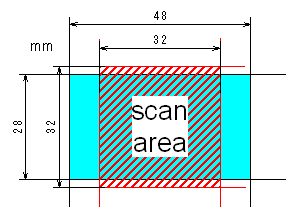
図1 スキャン試料サイズ.水色はスライドグラス.赤斜線の領域は走査領域.
Fig. 1 Recommended size of sample (light blue). Red shaded region is scanning area.
Size of scanning area & Size of sample
最適な試料サイズは,岩石用スライドグラス(28mm x 48mm)に接着した薄片ないし厚片です.走査領域は図1に示すように,スライドグラスの中央 32mm x 32mm の部分になります. 10/10に行った小改修で左右1cm程オフセットしてスキャン可能になりましたが,まだ試しておりません.試料の厚さは,経験的には1mm程度が美しく見える事がわかってます(後で詳述).
この走査領域サイズの制約により,サンプルは20mm-25mm角に収まる大きさが望ましいです.といいますのも,あまりに走査領域ぎりぎりですと,全体的な磁気構造が見えなく,あとで歯がゆい思いをするからです.
下記の厚さについても参考にしてください.
Figure 1 shows the recommended size of sample and nominal scanning area.
Our instrument is designed to scan a rock slice mounted on a ordinary slide glass (28mm x 48mm).
The scanning area is 32 x 32 mm of central part of the slide glass.
The best dimension of the sample is 1-mm-thick, 20-25 mm x mm slice.
I think a chip of core sample mounted on the slide glass is the best.
Although the maximum scanning area is 32 x 32 mm, it is often demanded to observe stray magnetic fields around the slightly small sample (e.g. 25 mm).
See also below.
Surface
試料表面は,センサーヘッドが引っかからない程度に平らであればかまいません.具体的には#800-#2000の研磨でも磁気像を撮る分には十分です.しかし,磁性鉱物と磁化の対応を見る事が磁気スキャンの目的である場合は,後に反射光学・電子顕微鏡ですぐに見られるよう,ダイヤモンドペーストで研磨しておくのがベストです.
試料はなるべく均質な厚さ(平行なサンプルと表現することあり)であることが望ましいです.10/10改修でサンプルの傾きは補正可能になりましたが,磁気像はサンプル厚さによる磁性鉱物の重畳によって大きく変化しますので,やはり平行は保った方が良いでしょう.
The surface of the sample should be flat, and be parallel to the slide glass.
Since one of the main purpose is to compare with SEM/BSE images, the best preparation is polishing by diamond paste.
If you do not need to use SEM/BSE, #2000 polishing is enough for good scanning.
Bulk NRM
これまでの所,バルクNRMの強さが10^-4 Am^2/kgのサンプルから”それなり”な磁気像が得られています.ベストは10^-3Am^2/kgより強いサンプルです.ノイズが「全く」見えません.
目安としては,スピナー(Molspin)で有意なザイダーベルド図が得られる様なサンプルは,薄片にしても見えると思います.SQUIDを用いなければならない様な弱いサンプルからは,例え5mmの厚さにしたところで有意な像は得られません.
To obtain a good magnetic image using 1mm-thick sample, sample need at least a bulk NRM intensity of ~10^-4 Am^2/kg. For the best scanning, it needs the intensity of 10^-3 Am^2/kg.
For a criterion, samples that can be measured by a spinner magnetometer (e.g. Molspin) give us good magnetic image even using thin section. Whereas samples that need a SQUID magnetometer does not make any clear magnetic images from >5-mm-thick plate.
Thickness
我々にはノウハウが不足しており,どのようなサンプル厚さがベストであるかについてはあまり良くわかっておりません.ただ,経験的にはバルクNRMと磁性鉱物のサンプル中での分布に大きく依存するようです.一つには,サンプル厚さの中での磁性鉱物の重なりの影響.もう一つには,マトリクス中の微細磁性鉱物の影響.そして,磁化が「偏在」しているか「均質」に分布しているか.この辺がいろいろ絡んでます.
まぁ,1mmくらいが作りやすいし見やすいと思いますよ.光学薄片は見たことないっす.
薄片試料について
衝撃変成を受けた花崗岩およびAllende(CV3)の薄片の磁気像を得る事に成功しております.
強く磁化した磁性鉱物を特定したいのなら,薄片試料がベストかと思います.
Unfortunately, we have only a few know-hows about the best thickness of the samples.
Generally, it depends on the bulk NRM intensities and distributions of carriers of the NRMs.
Thick samples tend to have fuzzy magnetic images due to overlapping of magnetic minerals, and thin samples (e.g. 1 mm) give us clear dipole-like features in magnetic images if the weak bulk NRMs are carried by specified minerals that are strongly magnetized.
Because the spatial resolution of this instrument is about 400-500 um, it cannot distinguish individual magnetic signature from SD assemblages, though it can observe a single dipole feature from an 80um magnetite. The dense SD assemblages, e.g. fine grained metals in the matrix, may generate a large dipole-like feature over whole sample. This sample-sized dipole feature can be removed by thinning of the sample.
Thus, if you want to find out specific materials that carries a bulk NRM, a thin sample (~1mm) will be the best. Thin sample is also good for LASER-selective thermal demagnetization.
Thin section
We have currently succeeded to obtain some dipole-like features from thin sections of;
Shocked granite,
Allende (CV3) carbonaceous chondrite.
It seems like that our instrument can decide the strongly magnetized minerals in the thin sections.